![ID-logo-colour_version_2.png]](https://answers.id.com.au/hs-fs/file-2628100188-png/images/ID-logo-colour_version_2.png?height=40&name=ID-logo-colour_version_2.png)
Housing Monitor is an online evidence base for local government planning, community and advocacy teams, combining demographic data with housing supply, demand and affordability data for your local government area in one place.
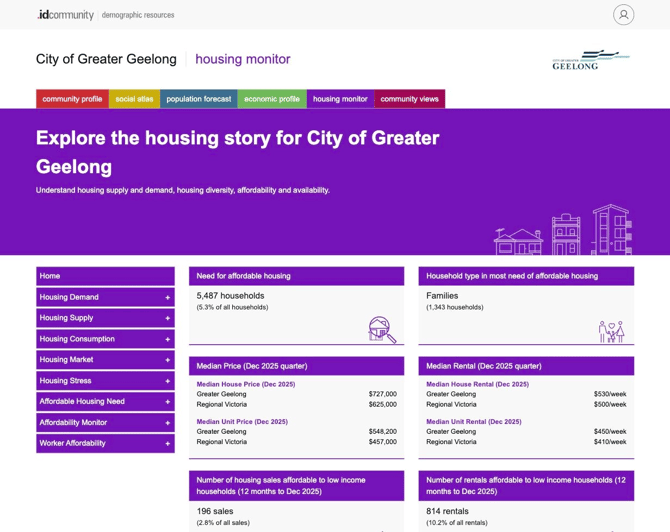
What Housing Monitor includes
Each Housing Monitor site opens on a home page dashboard of summary tiles, with the full content organised into nine sections in the left-hand menu. The sections expand into 41 question-led pages. Most measures are compared with a broader regional benchmark; many can also be viewed for small areas within the LGA.
- Home - an infographic-style dashboard of summary tiles presenting top-line statistics on affordable housing need, median house and unit prices and rentals, sales and rentals affordable to low-income households, population, new dwelling approvals, average household size and dominant dwelling types
- Housing Demand - how the population is changing, the age profile, the mix of household types, tenure types and household-type forecasts
- Housing Supply - dominant housing types, the mix of housing including bedrooms, residential building approvals by year and type and where new building is being approved
- Housing Consumption - who lives in what type of housing, household size by number of bedrooms, dwelling type by household type and how housing consumption patterns have changed and differ by area
- Housing Market - how house and unit sales and rental prices compare and have changed over time, as well as rental vacancy rates by area over time
- Housing Stress - the mix of incomes, rates of housing, mortgage and rental stress by income bracket and where stress is felt
- Affordable Housing Need - how many households have an unmet need for affordable housing, what types of renting households are in need and the types of homelessness and marginal housing people are experiencing
- Affordability Monitor - how the affordability and availability of buying and renting have changed over time for different household types, including where affordable housing is available to buy or rent
- Worker Affordability - how the affordability and availability of buying and renting have changed over time for local workers
Who uses Housing Monitor
Housing Monitor is designed for local government. Planning, community and economic development teams in councils use it to understand housing supply and demand, housing diversity, affordability and availability in their area, to advocate for their community's housing needs and to monitor progress toward local housing plans and actions.
Geographic coverage
Each Housing Monitor site covers a single local government area (LGA), with most indicators comparing the LGA against a broader region, for example Regional Victoria. Many topic pages also show how conditions differ across smaller areas within the LGA using ABS statistical areas (SA1 and SA2), for example 'Where is mortgage stress felt?', 'Where is new building happening?', 'How do housing consumption patterns differ by area?' and 'Where is affordable housing available to buy?'.
How to access Housing Monitor
Once a council has a subscription to Housing Monitor, anyone can view its site - you'll need to create a login, but viewing is free. Find your council's site in the A to Z directory at housing.id.com.au; if your council isn't listed, use the 'Add your community' link on the directory page to find out about a subscription for your council.